How do you read a mushroom dispensary menu?
Skeptically: a strain name is a cultivar label, not a tested category, and a menu line means little without a lab report for that batch. This page explains species and strain names, dried versus capsules versus edibles, what "lab-tested" should mean, and the red flags, with no dosing advice.
From our sister shop, My Mushroom Dispensary. Adults 21+ only.
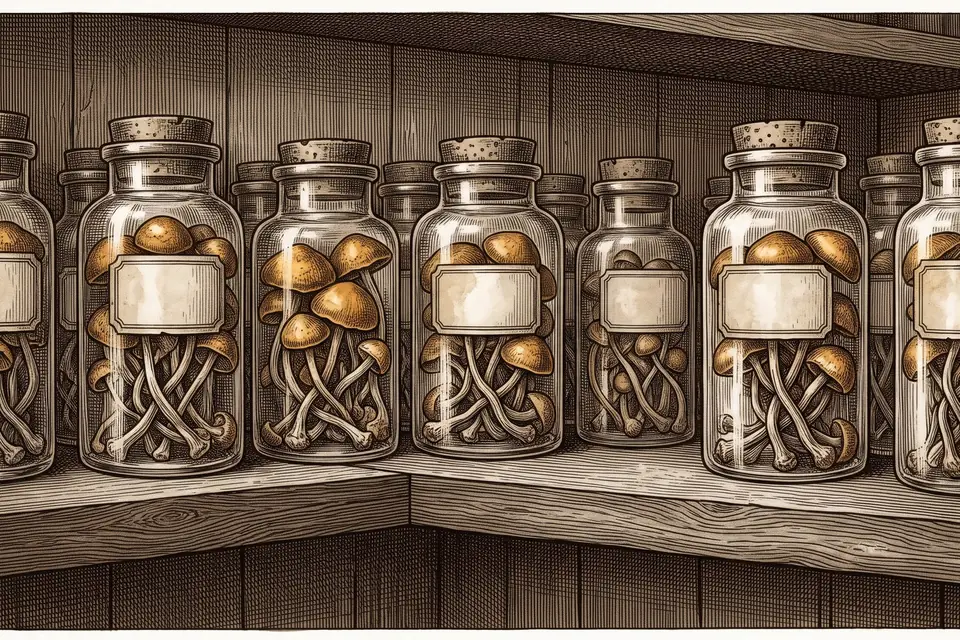
What does a mushroom dispensary menu actually tell you?
Less than it seems. A menu line usually gives a species, a strain name, a form and sometimes a potency figure, and only a lab report for that exact batch can back any of it up. No storefront or website menu is licensed, either: Oregon's tested, labeled psilocybin products are sold only to clients inside licensed service centers, for use there.1
Here's how the parts fit together. The online menu of My Mushroom Dispensary, the shop run by the people who publish this register, lists Albino Bluey Vuitton mushrooms: the species is Psilocybe cubensis, and Albino Bluey Vuitton is the strain, a cultivar name. Ordering from any menu by mail is illegal under federal law and in every state.
What's the difference between a species and a strain?
A species is a biological category; a strain is a name. Many menus list Psilocybe cubensis, the only species Oregon's licensed program allows. Oregon makes manufacturers prove it: the first harvest lot each year, and then the first batch harvested each month, must be tested to show it contains Psilocybe cubensis, and a batch that doesn't is a failure.2
Strain names such as Golden Teacher or Penis Envy are cultivar names that growers and sellers use for a line of mushrooms. They aren't tested categories. Oregon's testing rules cover species, potency, solvents, pesticides, contaminants and heavy metals; none of them tests or certifies a strain name.3
Lab measurements show why the name can't tell you potency. In a 2026 study of 14 Psilocybe cubensis strains produced under the same controlled conditions, psilocybin ranged from 2.03 to 19.60 mg per gram of dried mushroom between strains, and total tryptamines differed more than 7.8-fold. Within a single strain, psilocybin varied between individual mushrooms, with a coefficient of variation of 12.81% to 23.39%.4
So a strain name tells you a seller's label for a line of mushrooms. Only a test of that batch tells you what's in it, and even then individual mushrooms differ.
Dried, capsules or edibles: what's the difference?
Oregon's labeling rule names four product types: whole fungi, homogenized (ground) fungi, psilocybin extract and edible psilocybin product. Its labels must state the measured psilocybin content from lab results, that onset is "variable and cannot be accurately predicted," and that the "risks, benefits, and drug interactions of psilocybin are not fully understood."5 Unlicensed menus use the same forms with none of those checks.
| Form | What it is | What testing has shown |
|---|---|---|
| Dried whole mushrooms | The mushroom itself, dried ("whole fungi" in Oregon's rules) | Potency differs between strains and between mushrooms of the same strain4 |
| Capsules | Ground mushroom in a capsule | Grinding mixes material, but only testing shows the mix is even. Oregon fails a lot when duplicate samples differ by more than 20%6 |
| Edibles (gummies, chocolates) | Mushroom or extract in food, or sometimes no mushroom at all | Labels are often wrong. Colorado requires each tested serving to land within 15% of the label7 |
Edibles are where labels fail most clearly. When researchers tested 12 "magic mushroom" edibles bought at Portland shops, none contained psilocybin, including one gummy labeled with 100 mg of psilocybin per piece; 8 of the 12 contained ingredients the label didn't list.8 Our testing guide covers those studies and the 2024 illness outbreak.
What should "lab-tested" mean?
It should mean a certificate of analysis (COA): a lab report for one specific batch. A credible one shows all of these:
- The lab's name and accreditation. Oregon requires psilocybin testing labs to be accredited by its environmental lab accreditation program, ORELAP.9 Colorado's health department certifies testing facilities by category and asks for an ISO/IEC 17025 accreditation scope "if available."10 A report from an unnamed lab can't be checked.
- A batch or lot number that matches the package. Oregon tests every batch of finished product.6 A report for some other batch proves nothing about yours.
- A test date. Colorado repeats its tryptamine content analysis every nine months.7
- The method. Potency results should name a chromatography method, such as HPLC or LC-MS. The 2025 edibles study used a state-accredited HPLC method.8
- What was measured. At minimum, psilocybin and psilocin. Colorado also requires baeocystin, norbaeocystin and aeruginascin, plus a screen for the synthetic drug 4-AcO-DMT; any amount found fails the product.7 A report giving only a vague "mushroom extract" figure doesn't show psilocybin content.
- Contaminants. Microbes (Colorado requires Salmonella and Shiga toxin-producing E. coli to be absent) and heavy metals (Oregon sets limits for lead, cadmium, mercury and arsenic).711
- Pass or fail against stated limits, with a way to contact the lab.
We found no published study that has checked the reports unlicensed sellers hand out, so a report is only as good as its match to your package. And a real report doesn't make a sale legal; our guide to online mushroom dispensaries explains the federal law.
What are the red flags on a mushroom menu?
- "Legal," "compliant" or "licensed in Oregon" or "Colorado," next to shipping or counter sales. Neither state's license allows either; Oregon keeps purchase and use inside the service center.1 Our guide to the claims shops make goes through each one.
- Amanita sold as a magic mushroom. The FDA calls Amanita muscaria and its compounds "unapproved food additives."12 In one Portland study, two products sold as Amanita contained no muscimol but did contain psilocin and other tryptamine compounds.13
- Synthetic drug names on the label, such as 4-AcO-DMT ("psilacetin"), 4-AcO-MiPT or 4-HO-DET. These turned up in tested gummies,813 and Colorado's program fails any product with a synthetic tryptamine.7
- A "psilocybin-free" label on a product sold as psychedelic. One tested gummy labeled psilocybin-free contained psilocybin.13
- Potency figures with no batch report behind them. A number on a menu is a claim until a matching lab report backs it.
- Packaging that copies candy or brand-name foods. In a 2025 study of Canadian psilocybin stores, 30 of the 46 stores whose products it assessed (65.2%) sold products resembling brand-name foods.14
- Medical claims. In the same study, 19 of the 22 store websites with health content (86.4%) made mental-health claims.14
Questions people ask
Is one strain stronger than another?
You can't tell from the name. A 2026 lab study found large differences between strains and between mushrooms of the same strain, and no regulator tests or certifies strain names. Only a test of the batch measures potency.
What is a certificate of analysis?
A lab report for one batch. A credible one names an accredited or state-certified lab, matches the batch number on the package, gives a test date and method, measures psilocybin and psilocin, checks contaminants, and shows pass or fail against stated limits.
Does a lab report make buying legal?
No. Psilocybin is a Schedule I drug under federal law whether it's tested or not, and no state licenses a walk-in or mail-order seller.
Are Amanita mushrooms on a menu the same as magic mushrooms?
No. Amanita muscaria is a different mushroom with different compounds, muscimol and ibotenic acid. The FDA says those compounds are unapproved food additives, and tested products sold as Amanita have contained other drugs.
Why do menus list microdose capsules?
Capsules are a common form on unlicensed menus, often sold for microdosing. No state allows take-home microdoses. Our microdose page covers what the research and testing found.
Sources
- ORS chapter 475A, Oregon Psilocybin Services Act (ORS 475A.498), Oregon Legislature, 2025 edition, checked November 2, 2026.
- OAR 333-333-7030, Speciation Testing, Legal Information Institute reproduction of the Oregon Administrative Rules, checked November 2, 2026.
- OAR chapter 333, division 333, Oregon Psilocybin Services rules (testing rules 333-333-7010 to 7150), Legal Information Institute, checked November 2, 2026.
- Sharchaton A, et al. Surprising Variability in Tryptamine Profiles of Psilocybe cubensis Fruiting Bodies: Inter- and Intra-Strain Differences Across 14 Strains Cultivated Under Controlled Conditions, Journal of Fungi 2026;12:486, July 2, 2026.
- OAR 333-333-2400, Labeling, Legal Information Institute reproduction of the Oregon Administrative Rules, checked November 2, 2026.
- OAR 333-333-7040, Potency Testing, Legal Information Institute reproduction of the Oregon Administrative Rules, checked November 2, 2026.
- 1 CCR 213-1-4-4015, Required Regulated Natural Medicine Product Testing, Legal Information Institute reproduction of the Code of Colorado Regulations, version effective October 1, 2024.
- van Breemen RB, et al. Active Constituents of Psilocybin Mushroom Edibles, JAMA Network Open 2025;8(9):e2531345, September 11, 2025.
- Psilocybin Testing (ORELAP), Oregon Health Authority, checked November 2, 2026.
- Natural Medicine Testing Facility Inspection and Certification, Colorado Department of Public Health and Environment, checked November 2, 2026.
- OAR 333-333-7080, Heavy Metals Testing, Legal Information Institute reproduction of the Oregon Administrative Rules, checked November 2, 2026.
- FDA alerts industry and consumers about use of Amanita muscaria or its constituents in food, US Food and Drug Administration, December 18, 2024.
- Correia MS, et al. Quantitative analysis of recreational psychoactive mushroom gummies in Portland, Oregon, Clinical Toxicology 2025;63(4):261 to 266, published online February 20, 2025.
- Matsukubo J, Dickson S, Xiao J, et al. Psilocybin Dispensaries and Online Health Claims in Canada, JAMA Network Open 2025;8(4):e252853, April 1, 2025.
Keep reading
 What's actually in the mushroom gummies sold in shops?Lab tests of shop gummies and chocolates, the 2024 outbreak, Amanita warnings and how to read a lab report.
 Is there a microdose mushroom dispensary near me?No state lets a store or website sell take-home microdoses. What shops sell, what controlled studies found, and who should avoid it.
 Is it legal to buy from an online mushroom dispensary?Every online psilocybin shop sells outside the law. The federal mail and internet rules, seizure and scam risks, and what an honest shop shows.
Kept by the Dispensary Register editors. Facts on this page link to the sources they come from. Spot an error? Tell us and we'll correct it in the open, as our editorial standards describe. Psychedelic Mushroom Dispensary is a reference site, not a store. It is published by the people who run My Mushroom Dispensary, an online shop. We sell no advertising and nothing on this site.